
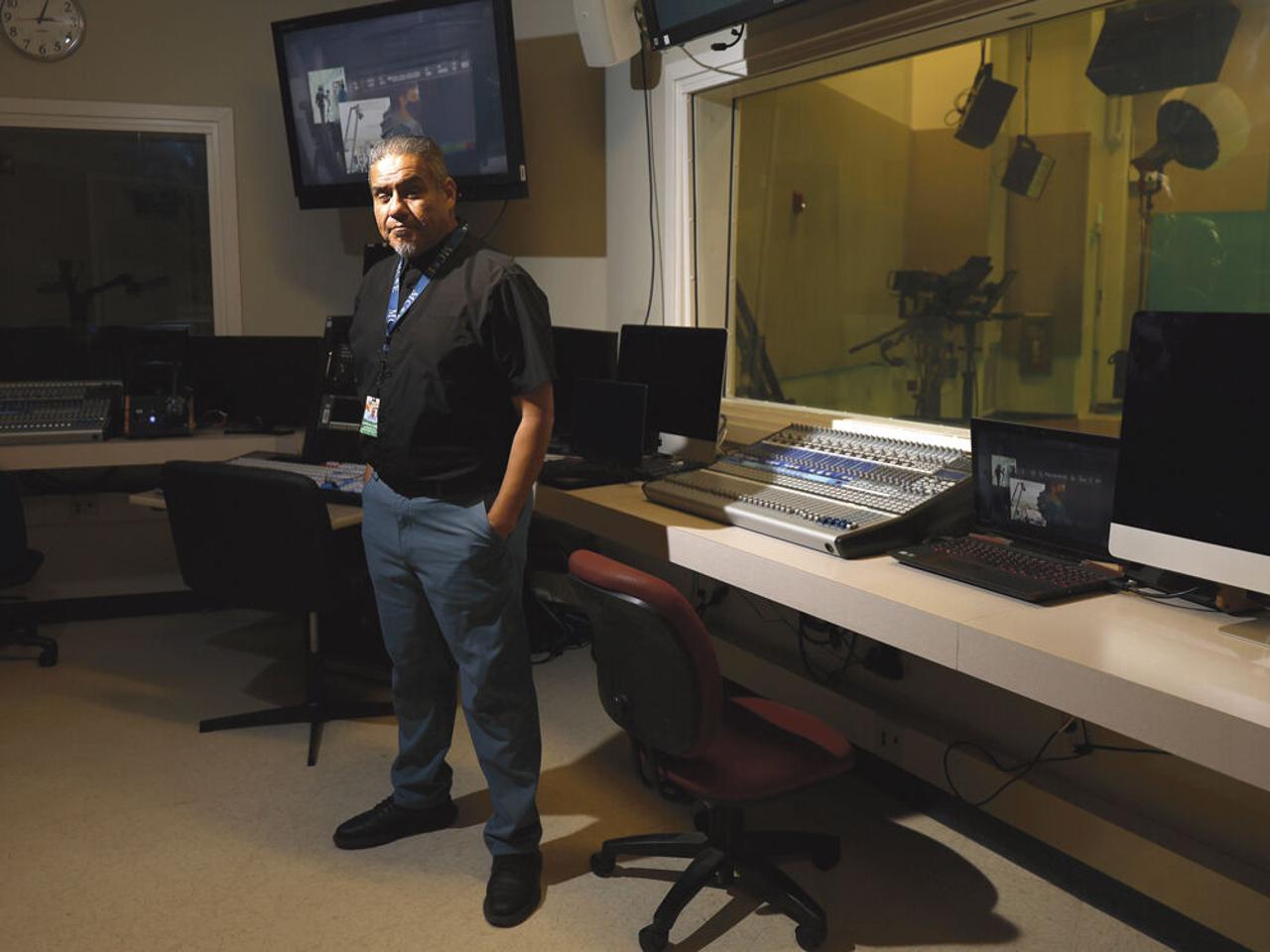

For the last six years, at the Media Center for Art, Education and Technology (MCAET) in Salinas, Director Emiliano Valdez has been quietly building something rare in public education: a place where professional-grade media production, arts education, and hands-on technology collide and where access, not exclusivity, is the organizing principle.
Valdez’s path to MCAET began long before he stepped behind and in front of the camera. Born into the Teatro Campesino family, he grew up on film sets and stages shaped by his uncle Luis Valdez and father Daniel Valdez, from the groundbreaking “Zoot Suit” to the now-classic biopic “La Bamba.” As a child, he saw theaters filled with Latino audiences who saw themselves reflected onstage for the first time. That early exposure, he says, erased any sense that Hollywood or storytelling was off-limits.
After studying broadcasting at Cal State Los Angeles and spending years designing after-school media programs across Hollister, San Benito, and Gilroy, Valdez moved fully into education. He helped found the Luis Valdez Leadership Academy in San Jose, teaching visual and performing arts before a former principal nudged him to look at a posting on EdJoin: director of MCAET, housed at the Monterey County Office of Education.
When he arrived, MCAET’s studio largely served a single charter high school. Valdez pushed to turn it into a countywide hub where any student—from fifth graders to college interns—could step behind a camera, into a podcast booth, or onto a soundstage.
A former KSBW news desk anchors the broadcast studio where students learn live production. Down the hall, a Fab Lab blurs the line between engineering and storytelling: robotics camps that turn the green-screen room into the surface of Mars, literacy projects where 3D-printed props bring children’s books to life, and animatronic creatures built with local artists for community Día de los Muertos events.
Beyond the building, MCAET’s paid internship program places college and older high school students in live civic broadcasts through PEG (Public, Educational, Government) contracts, including the City of Monterey’s council meetings. Interns earn $20 an hour while switching cameras, monitoring audio, and—often for the first time—hearing detailed debates on rent control and public spending. Valdez frames that work as “civics education in real time,” turning interns into better-informed community members as well as technicians.
For Valdez, who has watched art fuel social movements and open doors for his own family, MCAET’s mission comes back to one word: access. Whether it’s a city council control room, a podcast station in a rural school, or a black-box studio in Salinas, he wants Monterey County students—and their families—to see that media-making, like education itself, isn’t reserved for someone else. It’s a future they can step into, hands on the controls.
Salinas Valley Now: What made you actually decide to follow the teaching aspect of media, rather than follow in the footsteps of your uncle or your father?
Art is one of the great educators. It really is, and so when you think about arts being an educator, and then I intersect into that space, you know, I really am blessed and privileged to have been raised in that environment. My father and my uncle-they have never had a normal job in their life. They have been artists their entire life, and that was a dream of mine always. And it just happened that I found it in this particular avenue where I come to work not because it's just a job, but I come to work because it's an opportunity to spread that power of using art to educate.
With the advancement of AI, what are your overall thoughts on how you use it in film or broadcasting or with what you are doing here at MCAET?
I know that we have this purview that Hollywood has sold us that AI is going to take over the world and turn into robots and try to kill us. That’s a possibility for sure. I think education is evolving. I think we as people are evolving. I think keeping things human-centered is really important. And so I'm thankful that currently, right now, AI is requiring human interaction to function. I think when we look at AI, it's been around longer than we thought. I think we have to decide what serves us and what doesn't serve us, and I think that we have to get back to the human connection. So I think it's super important that we remain in this space that is somewhat neutral but still at the forefront of where we're at with technology.
Following that, where do you see the future of journalism?
Chris Cerney is a prime example. It doesn't take much anymore for someone to go out and capture their own stories. Every person has a different purview about what is important. And so, we just never know when there's something going on in a small town. We don't know what the issue is. We hear about it maybe, at the local grocery store, people talking, but our journalists can't be responsible for covering everything that happens because there's no way to do that. So, those stories that go untold, I think, need to be told. There's a lot of avoidance and absence of important stories in the world. It’s important to get students to open their eyes, their ears, and their hearts to what's going on in the world. I see journalism being very prominent in that, because it's also a great synergy for our ELA skills and how we use it, but at the same time, there's just a great code of ethics that I think kind of comes along with listening objectively, and again, providing access.
Is there a specific memory that stood out from when they filmed La Bamba?
I got a chance to be in a couple of scenes as a background actor, and that experience was great. I think my memory would have been specifically with the concert scene that is at the end of the movie, but all of Ritchie's family was on the set, his actual real family, his mom, his sisters. They were there just to watch this unfold. And so, this idea of telling a story about, you know, this Chicano rocker who nobody knew was Chicano at the time because his last name was Valens. Just the role of family and how my family was a part of this is beautiful and forever engrained.
What more do you want to implement at MCAET?
I would love to see more independent filmmakers turn to our spaces, which I'll tour you real quickly through. But I think something I really want to do before I leave here is I want to create a parent program for parents to come through and get certified and start giving adults this opportunity to shift into this kind of technology space to understand what that collaborative work looks like, and to be a part of our team, I think that's one of the things I had marked in my wishes for what would I do if I were in charge of MCAET was being to create a parent program at all levels, both at our you know STEAM design lab level engineering and all of that, but then also within our production teams as well.
Where do you see yourself in 10 years, or what mark do you hope to leave at MCAET?
What I've created would not be possible if it weren't for the previous directors that were here. They had vision to create the space. I did not design the space. I'm just using it a little bit differently to create access. But I do think that another person, coming in and working alongside myself and the team, is looking at the culture that MCAET has in terms of the way that we work together. It’s a lot like what I described to you about being on the set of La Bamba. Very familial, we're very close together, and it's just a great experience representing Monterey County in different places in different cities and things like that when we get hired to do things for other educational entities and so it's an amazing opportunity, but for myself, I think I'm always going to be a teacher at heart. I think one of the things that I would like to do post MCAET, is that I would love to just take all of the information and all of the education that I've amassed being in this wonderful place and learning how to share that story and help other agencies build similar programs like this because I think it's really important that we all provide access to those that don’t have it. The more that we do that, we just create a stronger economy, we create stronger drive amongst our community, more success, and it breeds just happier people.